
Finding foundation cracks, uneven floors, or gaps around doors and windows can make selling your home more complicated. You may wonder whether the problem is serious, how much repairs could cost, or whether buyers will consider the property without extensive structural work.
In New Castle, Delaware, the situation can involve additional considerations. Older properties near The Strand and the historic Green may have different construction needs from newer homes elsewhere in the area. Certain repairs may also require building permits, historic-area approval, or floodplain compliance.
You may be able to sell a house with foundation problems in New Castle, DE, without completing major repairs first. However, the property’s structural condition, applicable requirements, financing limitations, and disclosure obligations can affect your options.
This guide explains how to evaluate foundation concerns, understand local regulations, compare repair costs, and decide whether repairing or selling as-is makes more financial sense.
Can You Sell a House With Foundation Problems in New Castle, DE?
Yes. A house with foundation problems can generally be sold in Delaware, including as-is, provided applicable legal, safety, and contractual requirements are satisfied.
You do not necessarily need to repair every foundation issue before selling. Some buyers consider properties that need structural work, while others may require inspections or repairs before proceeding.
The important question is whether the issue involves minor cracking, active structural movement, water intrusion, or an unresolved safety concern.
A visible crack does not automatically mean the foundation is failing. Similarly, a house that appears stable can still have concealed problems.
Understanding the actual condition helps you make a more informed selling decision.
Foundation Warning Signs Homeowners Should Understand
Foundation concerns can appear in several ways. Some develop gradually, while others become noticeable after prolonged moisture exposure or building movement.
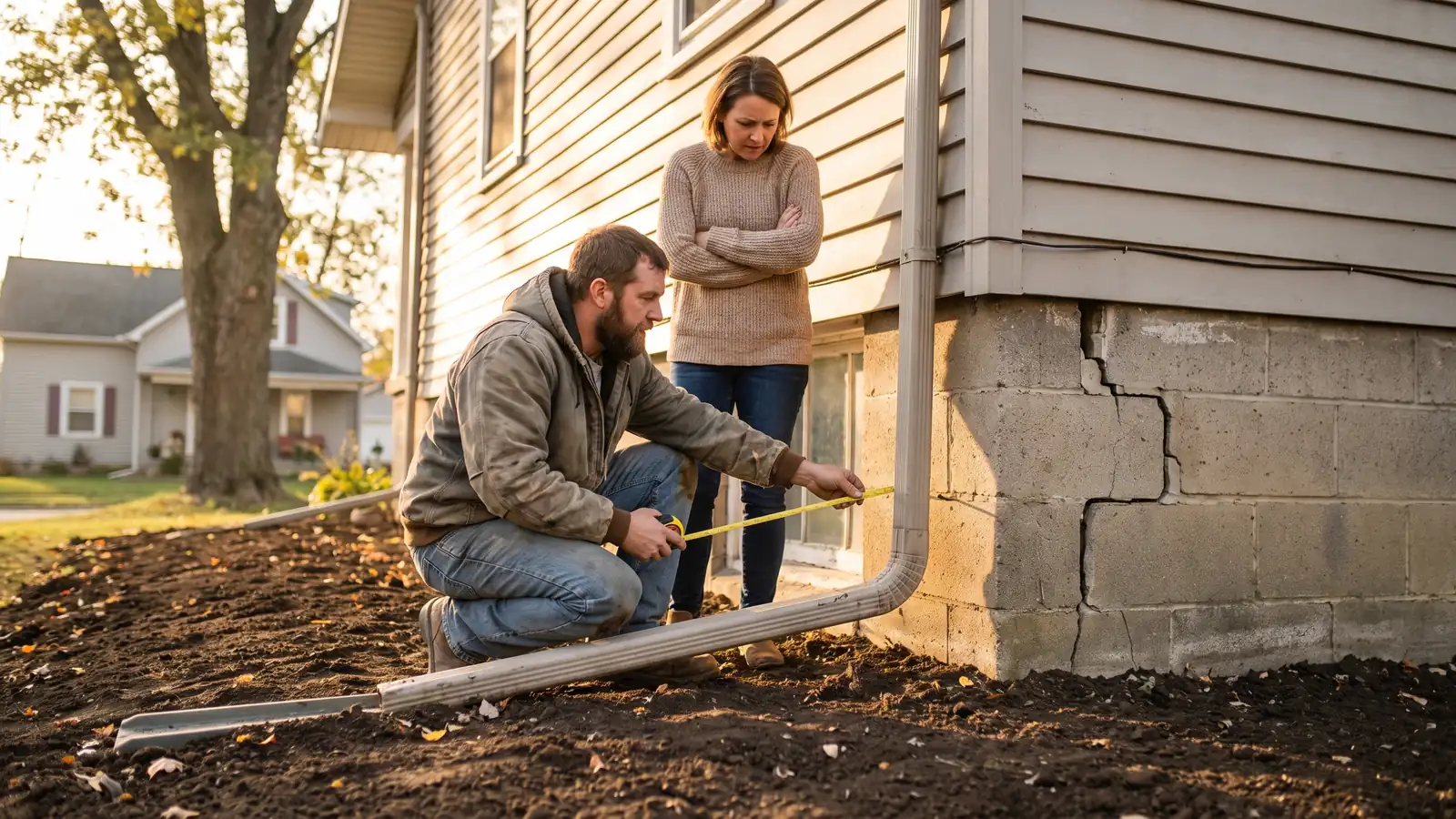
Cracks in Foundation Walls
Cracks may develop in concrete, brick, block, or other masonry materials.
Common patterns include:
- Vertical cracks: Sometimes associated with shrinkage or movement, although further investigation may be needed.
- Horizontal cracks: Can indicate pressure or wall displacement and deserve professional attention.
- Stair-step cracks: May suggest movement through masonry joints.
- Widening cracks: Can indicate an ongoing condition that requires evaluation.
The location, size, direction, and movement of a crack matter more than its appearance alone.
Uneven Floors and Sticking Doors
Floors that slope, doors that stop closing correctly, or windows that become difficult to operate may indicate building movement.
However, these symptoms can also result from ordinary wear, humidity, framing changes, or previous renovations.
If several symptoms appear together, consider a structural assessment.
Basement Moisture and Wall Separation
Persistent dampness, water staining, visible wall movement, or gaps between building components may indicate foundation or drainage problems.
The U.S. Department of Energy’s foundation drainage guidance explains how uncontrolled roof runoff can saturate surrounding soil and contribute to moisture problems.
Do not cover cracks or water stains merely to improve the property’s appearance before selling. Determine whether the underlying condition needs professional attention.
Foundation Cracks vs. Structural Damage: Know the Difference
Not all foundation defects require major reconstruction.
Some involve limited maintenance or waterproofing. Others may require wall stabilization, support repairs, or correction of settlement.
A qualified structural engineer can help distinguish these conditions.
What Does a Structural Engineer Check?
Depending on the property, an engineer may examine:
- Foundation cracking and displacement
- Signs of settlement or structural movement
- Wall, floor, and framing conditions
- Previous repairs or alterations
- Drainage and moisture-related concerns
- Whether additional investigation is necessary
A written report may explain the observed conditions, potential causes, and recommended next steps.
Should You Get an Inspection Before Selling?
An inspection can be worthwhile when the condition is significant or uncertain.
It may help buyers understand the problem and reduce disagreements based on assumptions.
However, not every as-is transaction requires the seller to commission a comprehensive engineering report.
If structural instability is suspected, prioritize safety and professional guidance before arranging buyer access.
How Much Does Foundation Repair Cost in New Castle?
Foundation repairs vary widely in cost because different conditions require different solutions.
A minor crack repair is not comparable to stabilizing a displaced wall or correcting substantial settlement.
Possible expenses include:
- Engineering assessments and drawings
- Structural stabilization or reinforcement
- Masonry and foundation-wall repairs
- Drainage improvements and waterproofing
- Excavation and soil-related work
- Repairing associated floors or utilities
- Permits and inspections
Compare Repair Estimates Carefully
One contractor may propose sealing cracks, while another recommends investigating settlement or correcting a drainage problem.
These proposals may address different issues.
Ask each contractor to explain the proposed work, expected outcome, necessary permits, exclusions, and what happens if additional damage is discovered.
The cheapest estimate is not necessarily the most effective repair.
Before committing money, compare the likely repair expenses with the property’s expected selling price and the available as-is offers.
New Castle Foundation Repairs: Permits and Local Requirements
The City of New Castle Building and Zoning Department oversees construction, building alterations, code enforcement, and applicable floodplain regulations within city limits.
Structural foundation repairs, excavation, or substantial building alterations may require permits and inspections.
City of New Castle vs. New Castle County
A property with a New Castle mailing address is not necessarily located within the incorporated city.
Some properties fall under New Castle County’s jurisdiction.
Before arranging repairs, verify the parcel’s location through New Castle County Property Owner Services.
County permit records and city permit records are not interchangeable.
Questions to Ask Before Foundation Repairs
Contact the responsible building department and confirm:
- Does the work require a building permit?
- Are engineering plans necessary?
- Are excavation or drainage approvals required?
- Will inspections be needed?
- Does the property have historic-district restrictions?
- Are floodplain regulations applicable?
The city’s Forms and Fees page provides building-permit and Historic Area Commission applications.
Understanding these requirements before hiring a contractor can reduce unnecessary delays.
Foundation Problems in New Castle’s Historic District
New Castle’s historic center contains buildings with architectural features and construction methods that differ from many modern homes.
Properties around The Strand, the Green, and nearby historic streets may have older masonry or structural components requiring specialized restoration methods.
However, an older house does not automatically have foundation problems, and every property should be evaluated individually.
Historic Area Commission Approval
The City of New Castle Historic Area Commission oversees work within designated historic districts.
The city’s guidance requires prior approval and a Historic Review Certificate for covered work.
Depending on the project, owners may need both historic-area approval and an applicable building permit.
Repairing Historic Foundations
Older brick or stone foundations may require materials and techniques compatible with the existing structure.
The city’s preservation guidelines encourage repairing historic materials rather than replacing them unnecessarily.
For example, a modern repair technique suitable for poured concrete may not be appropriate for every older masonry foundation.
Before beginning substantial work, ask whether the proposed methods satisfy both structural requirements and applicable historic-preservation standards.
These considerations can affect a buyer’s renovation budget and proposed purchase price.
New Castle Floodplain Rules and Foundation Repairs
New Castle’s location along the Delaware River makes floodplain requirements important for some properties.
Not every home in New Castle lies within a regulated floodplain. The actual address, mapped flood designation, and proposed work determine which requirements apply.
The city’s Floodplain Management guidance explains local construction standards for flood-prone areas.
Elevation and Freeboard Requirements
For properties within regulated floodplains, the City of New Castle requires certain new construction and substantially improved buildings to meet elevation standards, including 12 inches of freeboard above the base flood elevation.
Foundation repairs or extensive reconstruction may trigger additional requirements depending on the project’s scope.
The city’s published rules address flood elevations, foundation openings, building improvements, and other flood-related construction considerations.
Check the Property Before Renovating
You can review a property’s mapped flood designation through the FEMA Flood Map Service Center.
However, the map alone may not resolve every permitting question.
If the property is in a regulated floodplain, ask the city’s floodplain administrator whether the proposed work requires:
- Additional building approvals
- Engineering documentation
- Elevation certificates
- Flood-resistant materials
- Foundation openings or other protective features
Confirm applicability before committing to major foundation repairs.
A buyer considering an as-is purchase should also understand any outstanding floodplain-related obligations.
Water Damage Can Complicate Foundation Problems
Foundation damage and water intrusion may occur together, but they are not necessarily the same problem.
Water entering a basement can result from damaged drainage systems, grading issues, cracks, or other conditions.
The EPA’s basement moisture guidance explains that some moisture problems can be reduced by redirecting downspout runoff or improving grading.
More serious problems may require substantial professional work.
Waterproofing Is Not Always Structural Repair
Sealing a leak may help control moisture without stabilizing a moving foundation wall.
Likewise, a structural repair may not eliminate poor drainage.
If both conditions are present, ask qualified professionals whether separate repairs are necessary.
Water intrusion can also affect a property’s marketability and a buyer’s repair estimates. For related guidance, see our guide to selling a water-damaged house in Seaford, DE. New Castle’s permitting and floodplain requirements should be checked separately.
Can Buyers Finance a House With Foundation Problems?
Sometimes, but significant structural concerns may complicate mortgage approval.
A lender or appraiser may require additional investigation or repairs when a property has unresolved safety or structural issues.
Requirements vary by lender, financing program, and property condition.
This can reduce the number of buyers willing or able to purchase a significantly damaged home.
What About Cash Buyers?
Cash buyers generally do not depend on traditional mortgage financing, which may make some distressed-property transactions possible.
However, they may still require inspections, contractor estimates, title review, or contractual conditions.
A cash offer is not automatically guaranteed, and the buyer may account for the cost and uncertainty of structural repairs when determining the price.
Three Ways to Sell a House With Foundation Problems in New Castle
Choosing a selling method requires comparing more than the advertised sale price.
1. Repair the Foundation Before Listing
Repairing the problem may improve marketability and make the property more attractive to buyers seeking conventional financing.
However, the homeowner may need to pay for engineering, construction, permits, and additional holding expenses before selling.
This approach works best when the repairs are manageable and the likely increase in sale proceeds justifies the investment.
2. List the House As-Is With an Agent
An as-is listing provides open-market exposure without requiring the seller to complete every repair.
Buyers may still request inspections or negotiate based on structural concerns.
A real estate agent familiar with New Castle can help assess market conditions and establish an appropriate asking price.
However, financing limitations and repair uncertainty can affect the transaction.
3. Explore a Direct Cash Sale
Some professional buyers consider houses with foundation problems in their existing condition.
A direct offer may reduce the seller’s preparation and renovation responsibilities.
However, the proposed price may reflect estimated repair costs, structural risks, and the buyer’s intended use.
Learn how Dynamic Property Solutions reviews property information before requesting an offer.
The best option depends on actual repair estimates, market value, available funds, and your preferred timeline.
New Castle Example: Repairing the Foundation vs. Selling As-Is
This example is hypothetical and does not represent an actual New Castle transaction or offer from Dynamic Property Solutions.
Suppose a homeowner discovers foundation movement and recurring moisture problems.
An engineer recommends stabilization and drainage improvements.
The owner compares completing repairs before listing with accepting a direct as-is offer.
| Illustrative financial factor | Repair and list | Direct as-is sale |
|---|---|---|
| Estimated selling price | $310,000 | $252,000 |
| Foundation and drainage repairs | $38,000 | $0 |
| Selling and settlement expenses | $17,000 | $4,000 |
| Additional holding costs | $6,000 | $2,000 |
| Estimated proceeds before excluded obligations | $249,000 | $246,000 |
In this example, repairing and listing produces $3,000 more after the listed expenses.
However, an additional $5,000 in unexpected repairs would change the result in favor of the as-is scenario.
The figures exclude mortgage payoffs, liens, taxes, and other potential obligations.
This illustrates why net proceeds and repair uncertainty matter more than the highest expected selling price.
Compare written offers and realistic contractor estimates before making a decision.
Delaware Disclosure Requirements for Foundation Problems
A house sold as-is may still be subject to legal disclosure requirements.
Under Delaware’s Buyer Property Protection Act, sellers in covered residential transactions generally must disclose known material defects in writing, subject to statutory exceptions.
In a covered Delaware residential sale, sellers must disclose known material defects, which can include significant foundation movement, structural damage, and material water-intrusion problems.
Selling the property as-is does not automatically remove these disclosure obligations.
Disclosing Previous Foundation Repairs
Keep available repair records, engineering reports, permits, invoices, and warranty information.
Provide accurate information about known conditions and the work completed.
Do not claim that a foundation has been permanently repaired unless that statement is supported.
When the Cause of Foundation Damage Is Unclear
You do not need to invent a diagnosis.
Describe what you know and provide relevant existing reports.
For example, recurring basement cracks should not be represented as purely cosmetic if their cause has not been established.
When in doubt, seek guidance from an appropriate Delaware real estate professional or attorney.
Selling a House With Foundation Problems and Code Violations
Some properties have foundation concerns alongside outstanding municipal notices or other building issues.
A structural problem may have prompted an inspection or corrective-work requirement.
Before selling, review any notices and determine whether they impose deadlines or restrictions.
A sale does not automatically cancel municipal enforcement obligations.
For related information, see our guide to selling a house with code violations in Milford, DE. The specific requirements for a New Castle property must be confirmed with the responsible local authority.
Selling a Vacant or Inherited House With Foundation Problems
Vacant Properties
An unoccupied house can develop additional problems when moisture, leaks, or maintenance needs go unnoticed.
Insurance coverage and security arrangements may also require attention.
Our Delaware vacant-house selling guide explains related holding costs and property-management concerns.
Inherited Properties
If the house belongs to an estate or multiple heirs, confirm who can authorize repairs and approve the sale.
Structural repair expenses may create disagreements when beneficiaries have different priorities.
Our guide to selling an inherited house in Smyrna, DE explains Delaware probate and ownership considerations that may also be relevant.
Checklist Before Selling a New Castle House With Foundation Problems
Use this checklist before arranging repairs or accepting an offer.
- Document the condition. Photograph cracks, water intrusion, uneven floors, and other visible issues.
- Assess safety. Seek professional help if structural instability is suspected.
- Review existing reports. Collect engineering assessments and previous repair records.
- Compare estimates. Understand repair scope, costs, permits, and possible additional work.
- Confirm jurisdiction. Determine whether the property is inside New Castle city limits.
- Check historic-area rules. Verify whether special approvals are required.
- Review floodplain requirements. Confirm any additional construction standards.
- Prepare accurate disclosures. Identify known defects and outstanding notices.
- Compare selling options. Evaluate expected net proceeds rather than price alone.
- Review buyer conditions. Clarify inspections, financing, and repair responsibilities.
- Check outstanding obligations. Review mortgage balances, taxes, and liens.
- Confirm closing requirements. Work with an appropriate settlement professional.
For general questions about direct home sales, visit our Delaware home-selling FAQ page.
Frequently Asked Questions About Selling a House With Foundation Problems in New Castle, DE
1. Can I sell a house with foundation problems in New Castle, DE?
Yes. You can generally sell a house as-is, but applicable disclosure requirements, safety restrictions, title issues, and contract terms still apply.
2. Do I have to repair foundation cracks before selling?
Not always. Some buyers accept foundation issues as-is. Required repairs depend on property conditions, applicable regulations, financing requirements, and the purchase agreement.
3. Can a cash buyer purchase a New Castle house with foundation damage?
Possibly. Some cash buyers consider foundation-damaged homes, factoring in structural conditions, estimated repairs, location, title, and buying criteria.
4. Do foundation repairs require permits in New Castle, DE?
They may. Structural repairs and excavation can require permits. Confirm whether your property falls under the City of New Castle or New Castle County.
5. Do historic-district rules affect foundation repairs in New Castle?
Yes, for covered work within designated historic districts. Historic Area Commission approval may be required alongside a building permit.
6. Must I disclose foundation problems when selling in Delaware?
Generally, yes, in covered residential sales. Sellers must disclose known material defects, including significant structural problems, subject to statutory exemptions.
7. Can I sell a New Castle house with foundation problems in a floodplain?
Possibly. A sale may proceed, but floodplain rules can affect repairs and improvements. Verify the property’s flood designation and outstanding requirements.
8. Do I need a structural engineer’s report before selling?
Not always. An engineer’s report can clarify foundation movement, repair needs, and buyer concerns, but its necessity depends on the property and transaction.
Explore Your Options for Selling a House With Foundation Problems in New Castle, DE
Foundation problems can affect a home’s value, repair expenses, buyer financing, and selling timeline.
However, not every crack requires extensive structural work, and homeowners do not necessarily need to complete every repair before exploring a sale.
Start by understanding the property’s condition and comparing professional assessments with realistic selling options.
Dynamic Property Solutions considers direct purchases of houses in New Castle and other Delaware communities, including properties that may need significant repairs.
If you own a house with foundation concerns, you can request an evaluation and ask whether a no-obligation cash offer may be possible.
Visit our New Castle home-buying page, learn about Dynamic Property Solutions, or request a cash offer.
You can also contact our team or call (302) 222-2901 to discuss the property.
Compare the proposed price, repair responsibilities, closing terms, and available alternatives before making your decision.
Disclaimer: This article provides general educational information, not structural engineering, legal, construction, or financial advice. Property conditions, municipal requirements, and transaction obligations vary. Consult qualified professionals and responsible authorities before undertaking structural repairs or entering a binding sale agreement.