A roofer says your Dover house needs new shingles, but you are already planning to move. Maybe you noticed a ceiling stain after heavy rain, a buyer’s inspector found damaged flashing, or your insurer asked about the roof’s condition. Paying for a replacement before selling may not fit your budget.
You can potentially sell a house with a bad roof in Dover, DE, without replacing it yourself. The practical choice depends on whether the roof is merely aging or actively leaking, what you know and disclose, and whether a buyer can obtain financing and insurance. You can investigate a targeted repair, negotiate an as-is listing, or compare a direct cash offer.
Start with the condition and the numbers, not an automatic assumption that every aging roof must be replaced. Here’s how Dover homeowners can evaluate the options without overlooking Delaware disclosure requirements or local permit rules.
Can You Sell a House With a Bad Roof in Dover, DE?
Yes. Delaware does not impose a universal rule requiring every residential seller to install a new roof before a property changes hands. However, an active leak, compromised roof deck, or other serious defect may affect an appraisal, mortgage approval, buyer negotiations, or the purchase agreement.
Consider two houses. One has older shingles but no identified leaks. The other has water dripping into the attic and soft sheathing beneath missing shingles. Both sellers might describe their roofs as “bad,” yet the risks and likely repair obligations are quite different.
An as-is sale is a negotiated condition of the contract, not an exemption from disclosing known defects. A buyer may accept the existing roof, but a lender or insurer may have additional requirements.
Is the Roof Old, Leaking, or Structurally Damaged?
A useful roof assessment distinguishes age, localized failure, and broader deterioration.
An Older Roof With No Confirmed Leak
Shingles near the end of their expected service life may reduce buyer confidence or insurance options. Age alone does not establish that a roof is unsafe. Look for installation records, maintenance history, and an independent evaluation before promising replacement.
Missing Shingles or Failed Flashing
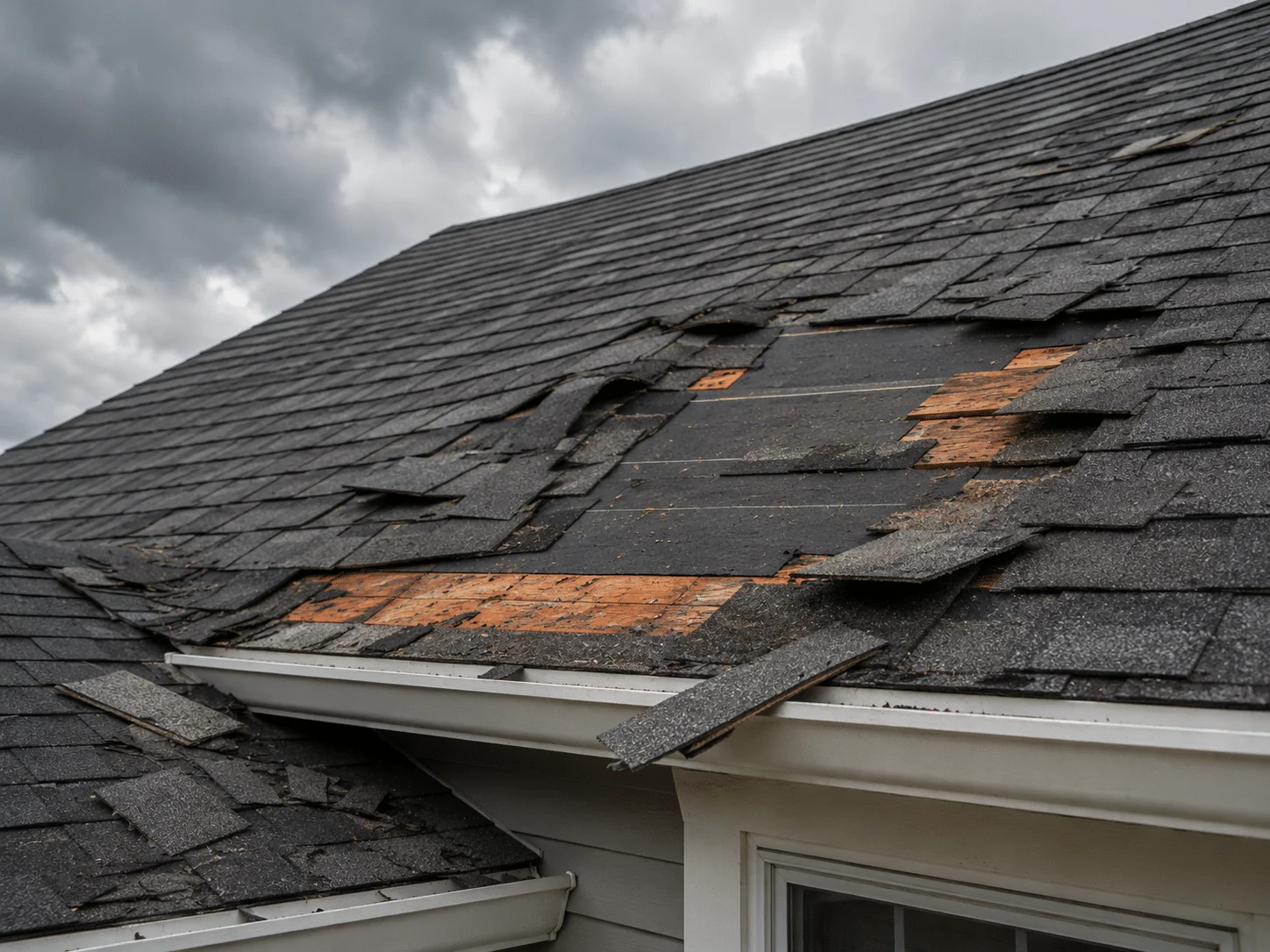
A few displaced shingles, defective pipe boots, or damaged flashing around a chimney may be repairable. The contractor should check underlying materials rather than estimating from a ground-level photograph alone.
Active Leaks and Damaged Roof Decking
An active leak can affect insulation, framing, ceilings, and interior finishes. The source may be some distance from the visible stain. If the deck is soft or structural members are damaged, obtain qualified evaluation and avoid unsafe access.
For selling decisions involving interior moisture, read our Seaford water-damaged house guide and Wilmington mold-selling guide.
What Should You Do Before Listing the House?
First, prevent additional damage where safe. Arrange a qualified roofer to identify the leak or defect, and take dated photographs of accessible damage. Do not climb onto a wet or unstable roof yourself.
Ask for a written assessment that separates immediate stabilization, localized repairs, and full replacement. An estimate should explain roof area, materials, underlayment, flashing, decking allowances, disposal, permits, and warranties where relevant.
Gather prior invoices, permits, warranties, inspection reports, and any insurance correspondence. If the original roofer is unavailable, ask a second contractor to review the scope rather than assuming the most expensive quote is correct.
If the house is under contract, identify the buyer’s objection and response deadline before authorizing major work. Our Newark failed-home-inspection article explains that negotiation process.
Dover Roof Permits: City Limits Versus Kent County
A Dover mailing address does not establish that the property is within Dover city limits. Determine the parcel’s jurisdiction before planning repairs.
For city properties, the City of Dover Planning and Inspections Department handles relevant building-permit questions. Its building permit application explicitly includes roof tear-offs, overlays, and roof-layer information. Contact the department at 302-736-7010 to establish the requirements for your specific project.
For properties under Kent County jurisdiction, the county permitting guidance treats roofing differently. Its published guidance identifies roof work involving replacement of more than 25% of sheathing as a permit-triggering project; county assistance also addresses changes in roofing material. Ask the county before relying on an exemption, particularly for structural work.
What If the Home Is in Dover’s Historic District?
Some older properties near The Green and downtown Dover may be subject to historic-district architectural review. The city’s Historic District Guidelines explain the design framework. If you plan to change visible materials, confirm whether an architectural review certificate is needed before ordering a new roof. Matching historic materials can change a contractor’s estimate.
Must You Disclose a Bad Roof When Selling in Delaware?
Under Delaware’s Buyer Property Protection Act, covered residential sellers must disclose known material defects, subject to statutory exemptions. Section 2572 requires the disclosure before signing the listing agreement and updates for material changes before settlement. Under § 2573, prospective buyers must receive the property-condition report before making an offer.
The Delaware Real Estate Commission’s current disclosure form is unusually specific about roofs. Its roof section asks for the installation date, number of roof-material layers, problems with the roof, flashing, gutters or skylights, repairs during ownership, and warranty transferability. Separate questions address previous water leakage and storm damage.
If you know the roof leaked last winter, do not mark the condition as problem-free because you painted the ceiling. If you do not know when the roof was installed, follow the form’s instructions for unknown answers rather than guessing. Keep any repair documentation with your records.
Selling as-is does not remove ordinary disclosure duties. Certain transactions qualify for statutory exemptions, but a typical homeowner sale should not assume an exemption applies. A Delaware real estate attorney can address unusual situations.
Can a Buyer Get a Mortgage on a House With a Bad Roof?
Possibly. Financing depends on the defect, appraisal findings, loan program, and lender’s requirements—not simply the roof’s age.
Fannie Mae’s property-condition guidance permits as-is appraisals for minor conditions that do not affect safety, soundness, or structural integrity. Its repair-completion rules specifically identify active roof leaks and worn shingles among conditions that can require correction when they affect those standards.
FHA, VA, USDA, and conventional loans have different underwriting and property requirements. A buyer’s agent may say a roof is “too old for financing,” but the specific lender should explain the actual condition, report, or repair requirement.
A seller credit cannot necessarily replace a lender-required repair. Before agreeing to a concession, ask whether the lender will close on the roof in its current condition, and obtain the answer through the transaction professionals.
Could a Buyer Have Trouble Getting Homeowners Insurance?
Yes. The property-insurance question is separate from whether the mortgage appraisal is acceptable. Some insurers may request photographs, an inspection, repairs, or further information before offering coverage, depending on their underwriting rules.
Do not claim that every roof older than 15 or 20 years is uninsurable. Roofing material, condition, claims history, insurer rules, and the specific policy matter. A buyer can ask an insurance agent to evaluate coverage options early instead of discovering a problem immediately before closing. The NAIC homeowners insurance overview explains how policies and covered losses vary.
If replacement is not feasible, written roofing documentation and a clearly priced as-is listing may help buyers understand what they are considering, though neither guarantees insurance or loan approval.
Will Homeowners Insurance Pay for a New Roof?
Not simply because the roof is old. Coverage depends on the policy and cause of damage. Wind or hail from a covered event may receive different treatment than long-term deterioration, installation defects, or neglected maintenance.
The Delaware Department of Insurance’s storm-claims guidance recommends documenting damage, notifying the insurer, and retaining receipts for necessary temporary repairs. Ask the carrier how a claim or proposed settlement affects a pending sale; do not promise a buyer that insurance money will automatically transfer.
Actual Cash Value Versus Replacement Cost
The National Association of Insurance Commissioners explains two common approaches. Actual cash value generally accounts for depreciation; replacement cost generally does not, although deductibles, exclusions, payment conditions, and roof-specific limitations may still apply.
For a covered claim, an insurer may pay in stages or require evidence of completed work to release recoverable depreciation. Review the actual estimate, deductible, mortgage-company endorsement requirements, and any claim deadline with the insurer.
A buyer should not calculate their offer assuming the seller will receive a full new roof through insurance. If a claim is unresolved, explain its status to the appropriate transaction professionals.
How Much Does a Roof Replacement Cost in Dover?
There is no reliable universal Dover price. Contractors consider roof area, pitch, access, material, existing layers, flashing, ventilation, decking condition, removal, and code or historic-review requirements.
Ask for two written scopes if appropriate: the least extensive repair that addresses the confirmed defect, and a complete replacement. Compare what each includes. A quote that excludes rotten sheathing, chimney flashing, disposal, permits, or interior repairs may understate the final bill.
Also ask about transferable manufacturer or workmanship warranties and whether the work could be completed before the planned closing. Do not mistake a low bid for a guaranteed total cost when the contractor has not examined the underlying decking.
Even if you plan to sell as-is, estimates provide evidence for negotiating a defensible price rather than accepting an unsupported demand for the cost of a luxury roof.
Four Ways to Sell a Dover House Without Automatically Replacing the Roof
1. Make a Targeted Repair
A localized leak or flashing defect may be fixable without replacing every roof plane. This approach can preserve a transaction when the buyer and lender accept the documented correction. Require a written scope, photographs, and receipts.
2. Replace the Roof Before Listing
Replacement can be worth evaluating if the roof is genuinely beyond repair and enough sale value may be recovered. But financing the work, securing permits, and waiting for installation introduce costs and risk. Do not assume the sale price increases dollar-for-dollar.
3. List As-Is and Price the Condition Accurately
A traditional buyer may accept responsibility for an aging roof in exchange for a price adjustment. Market the house honestly and provide known reports. Buyers with financing can still face lender or insurance conditions; an as-is label does not remove contingencies.
4. Compare a Direct Cash Purchase
Some buyers evaluate houses with aging or damaged roofs without requiring the seller to complete replacement first. An offer often reflects expected repairs, resale costs, and uncertainty and may be below a traditional listing price. Ask about inspections, fees, deposits, and closing conditions before choosing.
See how Dynamic Property Solutions buys Delaware properties and our guide to checking cash-home buyers.
Dover Example: Compare the Net Proceeds, Not Just the Offer
Imagine a Dover homeowner with aging shingles and a leak near a roof penetration. The homeowner obtains a hypothetical $19,000 replacement estimate and compares three selling approaches.
These numbers are illustrative only, not Dover market prices, contractor quotations, or offers from Dynamic Property Solutions.
| Financial factor | Replace and list | List as-is | Direct cash sale |
|---|---|---|---|
| Selling price | $342,000 | $316,000 | $292,000 |
| Mortgage payoff | $204,000 | $204,000 | $204,000 |
| Roof replacement | $19,000 | $0 | $0 |
| Selling and settlement expenses | $20,000 | $18,000 | $6,000 |
| Holding costs | $3,000 | $5,000 | $2,000 |
| Estimated net proceeds | $96,000 | $89,000 | $80,000 |
Here, replacement followed by listing produces $7,000 more than an as-is listing and $16,000 more than the modeled direct sale. But these scenarios assume each buyer can close at the specified price, the roof replacement stays within budget, and no additional damage is discovered.
If the contractor finds deteriorated sheathing and the repair bill increases by $8,000, the replace-and-list net falls to $88,000—slightly below the as-is estimate. Conversely, if targeted repairs satisfy the buyer, the seller might avoid most of the replacement expense.
Compare written offers, realistic costs, financing feasibility, and timing. A higher price is not necessarily a better outcome when the work could delay or defeat closing.
What If the Buyer Discovers Roof Problems After an Inspection?
Ask for the inspection findings and the buyer’s specific request. An inspector may report curling shingles, attic staining, or a possible leak but recommend further evaluation rather than a definitive replacement.
Review the inspection contingency, deadlines, and cancellation provisions before negotiating. Potential responses include an appropriately documented repair, a permitted seller credit, price adjustment, or contract termination when the agreement allows it.
Our Newark failed-inspection guide explains these steps, including why an inspection finding does not automatically cancel a sale.
What If the Roof Leak Has Damaged Ceilings or Walls?
A roof repair can stop incoming water but leave affected insulation, drywall, or framing behind. Ask whether the contractor’s scope covers those materials or only the exterior covering.
If dampness has persisted, moisture assessment may also be appropriate. See our Wilmington mold article. For larger property-condition decisions, read our Bear major-repairs guide.
Do not describe the interior as repaired simply because new shingles were installed. Retain photographs and invoices showing what was actually done.
What If the Dover House Is Vacant, Inherited, or Facing Financial Hardship?
Vacant: An unnoticed leak can worsen while a home is empty. Check appropriate insurance and arrange safe monitoring. Our Delaware vacant-house guide explains holding-cost considerations.
Inherited: The representative or heirs may need legal authority to approve roofing work or sell the property. See our Delaware inherited-property guide.
Financial hardship: A seller behind on property taxes or mortgage payments may need to compare urgent deadlines with repair costs. Read our Dover back-property-taxes guide before making assumptions about the time available.
Common Mistakes When Selling With a Bad Roof
- Assuming every old roof must be replaced: Verify condition and the buyer’s actual requirements.
- Covering stains without addressing the source: Cosmetic work does not repair a leak or erase disclosure obligations.
- Agreeing to a price cut without an estimate: A buyer’s allowance request may exceed the documented repair scope.
- Ignoring jurisdiction or historic review: Permit and material requirements may change the cost.
- Assuming insurance will replace an aging roof: Coverage depends on the specific policy and covered event.
- Promising a closing date before checking financing: Buyer insurance and loan conditions may remain unresolved.
Checklist Before Selling a House With Roof Problems in Dover
- Determine whether the issue is age, localized damage, or an active leak.
- Document damage and protect the home from additional water where safe.
- Obtain a qualified written assessment and relevant estimates.
- Locate previous roofing invoices, permits, warranties, and claim records.
- Confirm city, county, and any historic-district requirements.
- Complete Delaware property-condition disclosures accurately.
- Ask potential buyers about financing and insurance conditions.
- Compare written offers using estimated net proceeds.
- Record agreed repairs, credits, and deadlines in the contract.
- Keep documents for the buyer and settlement professionals.
For general direct-sale questions, visit our Delaware home-selling FAQs.
Frequently Asked Questions About Selling a House With a Bad Roof in Dover, DE
1. Can I sell a house with a bad roof in Dover, DE?
Yes, potentially. Buyers may accept the roof as-is, but disclosure, appraisal, insurance, and contract requirements still apply.
2. Do I have to replace the roof before selling in Delaware?
Not automatically. The roof’s condition, buyer agreement, lender, and applicable building requirements determine whether work is necessary.
3. Can a buyer get a mortgage on a house with an old roof?
Possibly. Financing depends on roof condition and the lender’s requirements. Active leaks or serious deterioration may require correction.
4. Must I disclose past roof leaks in Delaware?
Covered sellers must disclose known material defects and answer the state’s roof and water-leakage questions accurately.
5. Will homeowners insurance pay for a roof replacement?
Only if the damage qualifies under the policy. Ordinary aging or wear alone is not a guarantee of coverage.
6. Can I offer a credit instead of replacing the roof?
Sometimes. The buyer, lender, and loan program must permit the arrangement; a credit may not satisfy required repairs.
7. Can I sell my Dover house as-is with roof damage?
Potentially. An as-is sale may be possible, but known defects and applicable requirements still need attention.
8. Will a cash buyer purchase a Dover house that needs a new roof?
Some will consider it. Their offer and closing conditions depend on the property’s condition and anticipated work.
Explore Your Options for Selling a House With a Bad Roof in Dover, DE
A worn roof does not automatically make your Dover home impossible to sell. Whether you should repair, replace, or sell as-is depends on the confirmed damage, your available funds, and what each option would leave after expenses.
Dynamic Property Solutions considers direct purchases of properties in Dover and other Delaware communities, including some homes with roofing problems. A no-obligation offer gives you another comparison point; any purchase remains subject to the property’s condition, clear selling authority, and agreed terms.
Visit our Dover home-buying page, learn about Dynamic Property Solutions, or request an offer. You can also contact our team or call (302) 222-2901.
Before paying for a complete new roof, get the facts, confirm your buyer’s requirements, and compare your realistic net proceeds.
Disclaimer: This article provides general information, not legal, roofing, insurance, lending, tax, or financial advice. Permit requirements, disclosures, financing conditions, and contract obligations depend on the specific property and circumstances. Consult qualified Delaware professionals before making binding decisions.